Wednesday, August 1, 2018

ማስሊያ: The Amharic Calculator V2 QnA

I have updated my Amharic Calculator app, and it is now available here. Feel free to download it and leave a comment on how I could improve it. Criticism is always welcome!


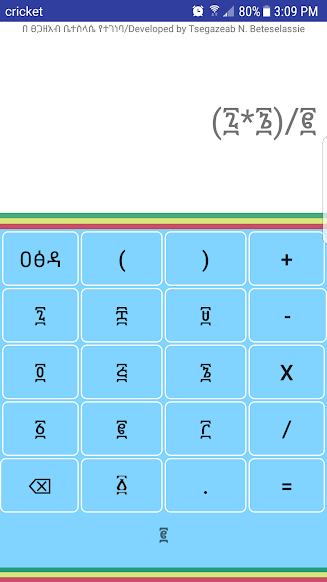
Screenshot Image
Screenshot of app in landscape mode (with numbers).

App Technical Information:


Q: What platform was used to create the app?

A: The coding platform used was Android Studio 3.1.3. Android Studio is an application made to help developers create and release apps on mobile. The primary languages used for coding are XML for the UI (User Interface) and Java for the functionality. However, it is possible to import new languages to use.

Link to download the latest version of Android Studio: https://developer.android.com/studio/

Q: What language is the app programmed in?

A: I used Java for the functionality (calculations, storing numbers, etc), and XML to create the layout and display XML is very similar to HTML, only the tags are much more varied. I didn't use much XML directly, but instead used the UI to drag and drop elements onto the test screen, only using XML for customization. I learned how to use these languages with Android Studio with this video series: https://www.youtube.com/playlist?list=PL6gx4Cwl9DGBsvRxJJOzG4r4k_zLKrnxl

Q: What device will work with the app?

A: Theoretically, any Android phone should work with the app. However, as one of the characters on the buttons is an image, the scaling of the character might be off on bigger or smaller devices (such as tablets). The recommended size of device to use the app is from 4.5 to 5 inches diagonally (the screen only, not the entire device).

Q: What font/language was used for the app?

A: The language used for the characters is Amharic, also known as Ethiopic. Since Ethiopic characters are not included on the keyboard, I used the Unicode equivalent of those characters in order to write it out. Unicode is how developers and other people write characters not included on the keyboard without having to copy and paste it. An example of a Unicode key that represents a character is U+1206, which represents ሆ.

Link to the Unicode website I used: https://unicode-table.com/en/

Q: How did you decide what to name the app?

A: I decided to name the app ማስሊያ: The Amharic Calculator to accurately describe what it does. It is a calculator that can calculate in Amharic, and the translation for calculator in Amharic was ማስሊያ, so I decided to name it ማስሊያ: The Amharic Calculator.

Q: What is the recommended resolution for the app?

A: The recommended resolution is 2560 x 1440. However, it is possible to use the app at lower resolutions as well. The recommended aspect ratio is 16:9, so that it can fill the screen without any leftover space. Rounded screens, such as smart watches, or very large screens, such as smart TVs are not recommended.

Q: How was the display of the app organized, and what does each part do?

A: The display was mainly organized using XML. At the top of the screen is where all the inputs and outputs are displayed. All the buttons are organized beneath it, including the number, operations, backspace, clear, and enter buttons. Underneath the buttons is where the previous answer is displayed, which can only be seen in portrait mode. If the phone is turned to landscape mode, the display and buttons will be shrunk a bit, and and to the left of them is a scrollable history, where all the answers are stored.


The below pictures are screenshots of the app in portrait mode with and without numbers.
Screenshot Image
Screenshot Image


Experience:

Q: What were some of the challenges faced in making the app?

A: In order to add the Amharic characters to the display, I had to redo how the calculator calculated. Since computers can only calculate using Hindu-Arabic numerals (1, 2, 3), I needed to make a "translator" to convert the Amharic number characters to numbers. That meant I had to get rid of all the display code and replace the numbers with Amharic characters. Another issue was that the "zero" button was not scaling properly on other devices, due to the fact that it is a custom image and images don't scale the same as regular characters. I researched in order to fix this issue, but was unable to.

Q: What solutions did you use to fix these problems?

A: To fix the display problem, I made a translator that converted Amharic numbers to numbers the computer can use. Also, since the calculator was based around English numbers, I got rid of all the variables that store the numbers and instead made them use Amharic for the entire time they were used. My attempt at fixing the scaling issue is to make several copies of the folders used to store the XML variable. Each folder is for different screen sizes, and therefore makes the calculator look smaller or bigger. However, I did not know how to actually make the app choose which file to use.

Q: What was some of the feedback given to you?

A: Below is some of the comments given to the previous version of my app. I used the feedback given to improve it:

"This is really interesting. It is functional, simple, and clean. I really like it. The theme also looks more Ethiopian. I can imagine the arduous task of mapping the actual numbers and the final result into their Geez equivalence. But it would be nice to have that in your next release. I have some minor suggestions, like replacing "ባዶ" by "ዐፅዳ" and renaming the app "መቀመሪያ" instead of "ካልኩሌተር". I am proud of you Tsegazeab (and your Dad should take some credit too)!"

"የመጀመሪያ ጥያቄ የመጣልኝ ዜሮ ቁጥር በ አማርኛም ሆነ በግእዝ እንዳለ ስለማላውቅ በምን እንደ ተካህኸው ማየት እና አፑ እንዴት እንደሚሰራ ማየት ነበር የተካኽው ፩ ሲሆን በትክክል ይሰራል ግን " አልቦ " የሚለው ቃል በግእዝ "ባዶ" የሚለውን ይተካል ባዶ ምንም ማለት ሲሆን "አልቦ" ግን ቁጥር በእንግሊዝኛ "ዜሮ " ሊሆን ይችላል የሚል አስተያየት አለኝ ልክ ከመሰለህ ተጠቀምበት። እግዚአብሔር ያሳድግህ ! ብራቮ ! I'M SO AMAZED BY YOUR HARD WORK ! CONGRATULATION !"

These are some of the reviews, while not offering advice, still thanked me for the application:

"This app is so amazing! I hope you don't mind if I tell all my friends how amazing my cousin"s app is! I AM SPEECHLESS! and (by the way, you created the first ethiopian zero!) CONGRATS!"

"Wow! He is a great inventor. I will show this to my kids. It is so easy to use. Congratulations."

"Great job Abuka. I think I shouldn't be surprised, coz I know how gifted you are. You just make me feel proud of you. Keep it up dear."

Wednesday, June 20, 2018

The Physics Simulator

Introduction/The Idea:

For my AP Physics End of Year project, we were asked to create something that shows our knowledge of our favorite physics topics. You could either make two short projects or one long project. The options for both were pretty much the same, but the amount of effort you put into it will determine whether it was a short project or a long one. The most chosen options were a teaching video, an engineering project, or experimental research. Since my favorite topic was kinematics and specifically projectile motion, I decided to make something that would show this while playing to my strengths. One of the other options that only a few people chose was to create a program that shows your knowledge using code. If you already had experience programming, then it would be considered a short project, However, my teacher said that if I put in a lot of work, then he would consider it a long project. Therefore, I decided to create a program on projectile motion.

After some thinking, I decided to create a projectile motion simulation that can calculate the distance traveled. I decided to do this instead of a simpler project because I had already experimented with creating canvas animations earlier in the year during my free time. I had ended up making a simple animation that dropped a square wherever you clicked on the canvas. I decided to build this into a full-fledged projectile simulation.

A Crash Course on Web Design:

The programming languages I used for the application were HTML, CSS, and Javascript. A good analogy to how these programming languages fit together to make web applications would be a person. HTML would be the actual "body" of the person. CSS would be the clothes they wear. Javascript would be the "brains" of the person. What HTML does, if you didn't already know, is that it gives the framework for your program. You use HTML to create buttons, text boxes, containers, and links. CSS, on the other had, is what is used to style the pages you made in HTML. Normal HTML pages are very basic and unaesthetic. CSS helps to position elements, change the color, size and borders they have, resize elements for different browsers, and generally give the website "style". Javascript gives the web page functionality. It tells the web page what to do when a button is pressed, or a picture is clicked, or when the page loads. This is what I used to animate my simulation.  I'll only go over the HTML and CSS  code briefly, as most of the work I did was in Javascript.


How It Works (the code):

The HTML in my project basically set up all the inputs and outputs I needed for my program. The inputs are what will be used to set properties for each projectile that is fired. These include buttons, textboxes, and dropdown menus. The output, of course, is the canvas itself. The CSS moved the different elements around to make it easier to work with, along with giving it a color scheme and overall making it look nicer. The Javascript is what animates the projectiles in the program. What this section will cover is mainly focused on this.

Basically, how it works is that when the page loads, several variables and arrays are created for the more important data that needs to be saved. A variable is a way to store data without having to write it all out. An array is a way to store data without having to manually make multiple variables. It's best to store data this way due to it being easier to make and fix. Imagine having to describe all the features of a person just to call them to you. It's much easier to just give that person a name and use that instead. The name represents the person, just as the variable represents the data. Once this is done, it automatically runs the program once, just to show the user what the simulation does. I'll get into how that works later. Whenever you press the go button, it uses the DOM (a way to access HTML elements with Javascript) to get all the values you set in the Settings tab and put them into variables. This is what the createObjectOnClick() function does. A function is basically a way to run the same code over and over without having to type it out. Think of the person example I gave for variables. Instead of having to describe the same properties every time you want the person to come, giving it a name and using that is easier. Only this time, instead of giving a name to a bunch of data, you are giving a name to a bunch of code.

Lines 1-13 are where I declare my global variables and arrays. 
Lines 213-237 are where I declare the variables for each property the projectile will have.
At the bottom, lines 310-312 push the variable properties into each created instance (or copy) of the object. Then that gets put into an array that has all the properties of the projectiles.
Now here comes the interesting part: how it's animated. Once the createObjectOnClick() function finishes putting the properties of the object into variables, it actually gives it to the object. Remember those variables and arrays that were declared when the page loaded? Among those is an array called allObjectsCreated, and it stores the Objects that are created whenever you press the go button. Notice how I capitalized the word "objects". That's because in Javascript, there are something called Objects, which are basically arrays that can store code as well as regular data, They are helpful for storing properties of whatever you want, such as color and size, as well as functions to run. In this case, the object stores all the properties createObjectOnClick() made. It also stores an update() function, which basically tells the object what to do based on whether it touched the ground or not. If it is not touching the ground, it will keep accelerating the object downwards based on the gravity value. If it is, and bouncing is turned on in settings, it will flip the velocity to a positive in order to make it go upward. This part of the function is run every 20 milliseconds, and runs for all the projectiles in the simulation. However, since there is only one object, then in order to be able to save for multiple properties, the keyword new has to be used in createObjectOnClick(). This basically makes a new object at runtime that stores the properties. This new object is put into an array, which is how you access each projectile. In this way, you can create many objects and not have the code break.
Lines 47-71 handle what happens when the projectile hits the ground.

Now this next part explains what you might have noticed earlier: how the code is actually made to run every 20 milliseconds. In order to do this, you have to use the setInterval(arg1, arg2) method. This is a default method in Javascript and makes whatever the code you write in arg1 repeat for however many milliseconds you put in arg2. You can put a function in arg1, which is what I did so I don't have to run a giant block of code within the parenthesis. Also, to make the function creatObjectOnClick() actually run once, all you have to do is declare it with parenthesis outside of where it is called. So you create the function like this (ignore the brackets): [ function foo() {//code} ] and call it like this[ foo() ].

Anyways, that is how the most important bits of my program work. Everything else deals with smaller issues such as creating a pop-up when certain conditions are met and looping through the array that holds the properties of all the objects.


Final Product:

My final product is a projectile motion simulator that calculates the distance it travels while helping you learn different facts about projectile motion in general. It's features include:

- projectile motion visuals

- customizable:
    -gravity
    -initial velocity
    -friction
    -projectile type
    -cliff height
    -launch angle

-projectile tracing (can be turned off)

-bouncing (can be turned off)

-sliding (can be turned off)

-wall bouncing (can be turned off)

-learning popups (can be turned off)

It is a valuable tool to teach students about projectile motion and kinematics while still being entertaining and fun to use.

Monday, September 4, 2017

My New App: The Amharic Calculator

   ካልኩሌተር: The Amharic Calculator- screenshot


ይህ የሂሳብ ማስሊያ (ካልኩሌተር) በገጹም ሆነ በይዘቱ ኢትዮጵያዊነት የተላበሰ እና ለመሰረታዊ የሂሳብ ስሌት ስራ እንከን የለሽ አገልግሎት ይሰጣል።  በተጨማሪም ይህ የስልክ-ቁስ (አፕ)፦

- 100% ነጻ እና ማስታወቂያ የሌለው
- ልዩ ኢትዮጵያዊ እሴትን የሚያሳይ ጠቃሚ የሂሳብ ማስሊያ ካልኩሌተር ነው
- የአማርኛ/ግዕዝ ቁጥሮች እና ምልክቶች በሁሉም ቁልፎች ላይ አለው
- የተሳሳተ የስሌት ትዕዛዝን የሚጠቁም የአማርኛ መልዕክት ይጽፋል
- በአግድሞሽ ሲቀመጥ የቀድሞ ስሌቶችን ውጤት የሚስታውስ የስሌት ታሪክ አምድ ያሳያል
- ከስር የቀድሞ ስሌት ውጤት ምን እንደነበር ጽፎ ያሳያል

በሉ በሞቴ በሳንቃው ደረቴ! አሁን ስልክዎ ላይ ጭነው ሞክሩት፤ አስተያየትዎንም ይጻፉ፤ ለሌሎችም ያሳውቁ።
--------------------------------------------------------------------------------------------------------------------------
This Amharic Calculator is an app with the following unique features:

- It is 100% FREE with NO ads!
- It is an Ethiopianized basic math calculator!
- It has Amharic/Geez numbers on each button!
- Error messages are displayed in Amharic and English!
- Landscape mode shows the previous results as history!
- Recent history is displayed in portrait mode!

Download it for free today!

Link: play.google.com/store/apps/details?id=com.abukatech.amhariccalculator

Thursday, August 6, 2015

Gauss Explained

So I was reading this really great book called the Joy of X, and in the first chapter, it had an explanation of Gauss's (is that how you write it?) Formula of adding the numbers 1-100 without going 1+2+3+4... There are a bunch of techniques for this but the one I like best is the Triangle method. So, lets say you're back at elementary school and your teacher is having a bad day, so she gives you a challenge. "Can you add up all the numbers from 1 to 100?". Then, the teacher, confident that they couldn't solve it, leans back and relaxes, drinking a cup of dark coffee. But you're very smart, so you decide to play around with the problem before solving it. And, just for no reason, you make a triangle out of the problem: x xx xxx xxxx xxxxx xxxxxx xxxxxxx xxxxxxxx xxxxxxxxx xxxxxxxxxx And just for kicks, you decide to mirror it like so: oooooooooo xooooooooo xxoooooooo xxxooooooo xxxxoooooo xxxxxooooo xxxxxxoooo xxxxxxxooo xxxxxxxxoo xxxxxxxxxo xxxxxxxxxx So what do you do now? Well, let's say the total number of x's and o's are called "S". And remember the formula for the area of a triangle? It was bh/2. And these sure look like triangles, don't they? So you can apply the formula to them. So it would look like this: S=bh/2 Or, if you substitute b for n: S=nh/2 But, you realize, it isn't a perfect square. The x's and o's make a rectangle, so how would you account for that? The total thing is a rectangle because on the very top and bottom rows, it is filled with just x's and just o's. So it makes it into a rectangle. And so to account for that, You can do this: S=nh+1/2 Or, if you want to make it easier to read: S=n(h+1)/2 You can add the parenthesis because nh is equal to n(h) because both mean they are being multiplied. But h, the height is just the same thing as n, because both are made of x's and o's. So the formula can look like this: S=n(n+1)/2 Which is what the actual formula looks like! That teacher must have been very impressed.

Saturday, February 14, 2015

Why Is the Sky Blue?


By: Tsegazeab Beteselassie


Why Is the Sky Blue?
Source: gizmodo.com
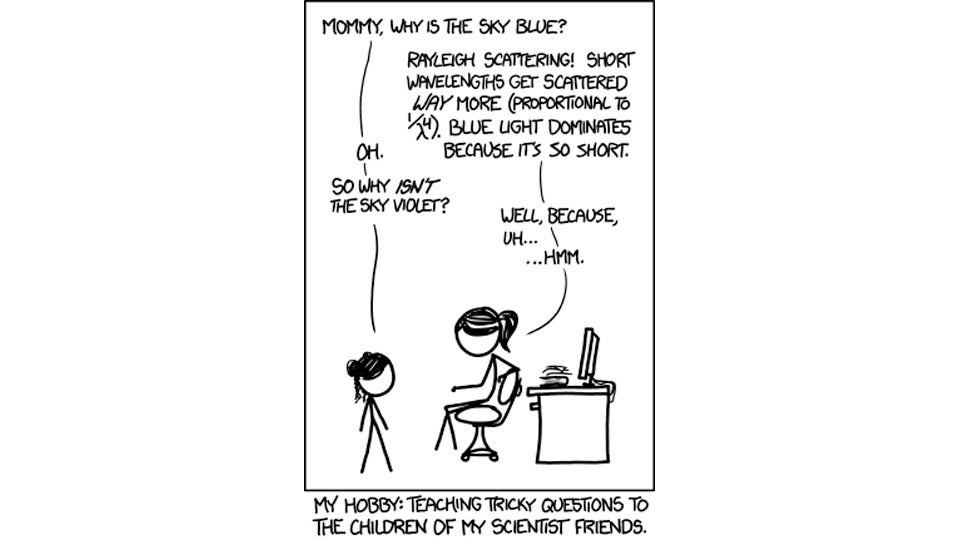
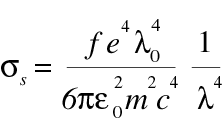
    Why is the sky blue? I'm pretty sure that when you were a child,you asked your parents that (I certainly did). And maybe they muttered something about the refraction of light and prisms and the colors of the rainbow. And when you searched it on Google, you got the exact same thing. You probably didn't, but still. And just maybe, you are still wondering why the sky is blue and not a different color. So you went to my blog to find out the answer. And so, now you want to know why it's blue. So, instead of wasting your time, I'll tell you right away. The light bounces off the air molecules and produce a visible effect of a multitude of colors, but since the blue light's wavelength is shorter than the others, then it'll scatter by a complex formula that goes like:
Or something like it. Didn't understand that? Time to go into deeper explanation.

Friday, October 24, 2014

The World in Your Eyes

By: Tsegazeab Beteselassie


Internet Contacts 1: Can you have contacts with Wi-Fi?
Link:io9.com
        Have you ever saw your friend in a classroom that was completely were zoned out, and then the teacher (seeing how helpless he was) calls him to tell you the answer to a problem, and he just stares and think "Boy, I wish I had my phone with that calculator I never used". And have you ever thought that it would have been really helpful if there was a way for him to find information without having to sneak his phone to school? Well now, recent developments in engineering have shown that it is possible to have the internet EVERYWERE. Scientists and engineers have worked together to make a primitive way of using contact lenses to carry the internet wherever you go. In other words, that friend of yours would be really happy.

    So how does this marvelous system work? Well, there is a circular antenna around the perimeter of the lens, which has a circuit that is holding up a LED at the center of the lens. The antenna is used to communicate with the computer that the scientists control so that they can monitor and change the color of the lens and what it does. The people that made this lens have already tested it on animals safely, namely rabbits. They are now planning to make a multi-pixel display so that you can organize your inbox, use the google calculator, and one of the most important uses, see Facebook profiles of strangers (you want to know who your saying hi to!). You can even wear eyeglasses with the LED display if you don't like contacts (like me). However, there could be a couple problems.

Tuesday, October 7, 2014

Antimatter Drive

By: Tsegazeab Beteselassie


Antimatter Drive: This is what an antimatter drive might look like.
Source:sciencegravity.blogspot.com-
 
     When you were a little kid (like me), have you ever wanted to travel to the stars? I bet you did. Well, right now, you can't go to the stars.
 Not for long.
Really, the only reasons why were not at Alpha Centauri (nearest star besides the sun) right now is because:
  •  The cost to even go to the moon was more than a billion dollars.
  • It is really really really really far.
  • We don't have the technology to get there within the span of a human lifetime.
    That's it. Only three problems to get to anywhere in the universe. Of course, they are much bigger than they appear. But still, only three problems. Scientists have been trying to find ways to propel spacecraft through space, and they have devised many ways to solve this problem. I am here now to talk about one of these solutions. It is a very smart solution, and the name of it is called the antimatter drive.

Wednesday, August 13, 2014

Theory of the Stars*

By: Tsegazeab Beteselassie


The Sun: This is what the sun looks like (with glare protection,
probably).

     Most people know that the sun was born 4.57 billion years ago. But what I was thinking was, about an important property of light, that actually might make the birth of the sun a few million years back. But before I explain my theory, I have to explain how the sun was born.
 
     When a star dies, usually what happens is that stars start to shed it's outer layers. For many years, scientists didn't know why. Then, a person named Emanuel Swedenborg first proposed a theory that stars were formed by nebula's in space. You probably want to know what a nebula is. Well, it's when a large mass of atoms form a cloud in interstellar space. One of the most distinguishing facts about nebula's is that they are created by the death throes of a dying star.
 
    When a star starts dying, it means that the core of the star has started to make iron. But how does a flaming mass of hydrogen create an element like iron? Well, here's how.
First, when the star is born, it immediately starts fusing together hydrogen to make helium. The reason it does this immediately is sort of part of my theory. When the star gives out light, it means that it is fusing hydrogen together to make helium. But we don't know it's ready until it gives out light, don't we? Well, anyways, the heat forces repelling hydrogen atoms to fuse to helium. Helium's mass is less that it should be because some of the mass is converted into energy, some of it as, light, the rest, heat. This small observation is crucial to why a star dies at a certain element. Anyways, this process isn't supposed to get past helium, because we still have enough hydrogen. But what happens when we run out?

Sunday, March 2, 2014

The Process of Fusion

By: Tsegazeab Beteselassie


Fusion: An animation of fusion.
Link: www.newgrounds.com
    Fusion is the universe's true power. It is what drives stars. Fission, splitting atoms, releases only so much energy. But fusion is so powerful, a kilometer of seawater can equal the worlds' oil reserves (in terms of energy). If only we can master this powerful force. But there is a possibility. And the possibility is called HiPER.

    HiPER stands for European High Power laser Energy Research facility. This ambitious group of people think lasers are the way to go in order to master the power of fusion. There are other ways, but they are focused on this one. They have a plan too. But first, let's take a look at the energy problems were facing.

    People predict that between 2000 and 2030, the global energy demand will go up by 70%. This means that we will need a generating capacity (for the world) of 5,800 gigabytes. That's five times the present energy capacity of the United States. They say that only laser fusion can stop this demand for energy. It is expensive, but it will reap benefits that greatly overwhelm the expense. 

    But what is this "plan?" How does it work? Will it work? They haven't tested it yet, but they will try. And now, I will show you the plan. 

    Since it is a little hard to explain, I will show you in this video.

Email me at: tsegazeab12@outlook.com or tsegazeab12@gmail.com. Thank you and subscribe!

Saturday, February 22, 2014

Time Travel 2

By: Tsegazeab Beteselassie   
   
 
Warping space-time: This is an artist's representation of space-time being warped.
Link:kuark.org
    As you saw in my first time travel blog, (Time Travel: Into the Future, and Time Travel: Into the Past) there were two separate things that I had to do in order to time travel both into the future, and into the past. However, there is a better solution to this, that can use the same (or almost the same) way to time travel. It involves superfluids, speeds of light, and of course, time travel. Keep on reading in order to see what this solution is.
 
    First, lets think of a normal fictional time travel machine. You just get into the machine, press a few dials, and zip! Your there. However, the reality is much different. We can't actually tame time and force it to flow backwards for everybody. However, we can go through it. The reason why is that space and time are interconnected, in something called space-time. This was predicted in Einstein's theory of general relativity. I think this is one of the reasons that we experience time. But there's more. As gravity is produced by warping space-time with large bodies, and since space and time is interconnected, Einstein came to the conclusion that the larger the body, the more space, and time, is warped.*

Saturday, February 1, 2014

Hypervelocty Stars: What are They?

By: Tsegazeab Beteselassie

Supermassive black hole: This is the start of a hypervelocity star.
Link:www.livescience.com 
In our galaxy, there are millions of millions of stars. Since our galaxy is a spiral galaxy, the spirals are spinning. That means our star, and every star, is moving very, very, fast, up to a million miles per hour. But not relative to each other. But there is a class of stars that are moving the same speed, but in a very different way. They are called "Hypervelocity Stars".
 
    What are they? You may ask. Well, they are stars that can travel up to a million miles per hour. That seems normal because normal stars are traveling the same speed. But that speed is not relative. So compared to other stars, hypervelocity stars are moving a million more miles an hour. That's 0.2% of the speed of light! But how can these hypervelocity stars move that fast?
 
    Since stars move at a million miles per hour, and since their should be tiny differences, shouldn't the faster ones be the hypervelocity stars? The answer is no. The reason is that most velocities (except the speed of light) add up. So the stars can't be the faster ones in a spiral galaxy. Also there is another problem. Stars like these come like, once in every ten thousand years. I don't think that there is a means to propel a star a million more miles per hour in a spiral arm. So we need another theory. But what other reason could they're be for a hypervelocity star?

Sunday, January 12, 2014

Life and Death of a Star

By: Tsegazeab Beteselassie


Hypernova: This is an artists representation of a hypernova.
Picture is from:scitechdaily.com 
On a clear night, if you ever had looked at the sky, you will see stars scattered through the sky. We should know about them, because their death made our sun, and eventually, us. Our sun was created from dust clouds in the night sky, which were the remains of dead stars. The clouds were, in turn, made by supernova explosions. But lets rewind to the moment a star was born.
 
    We will start with a dust cloud, floating through the sky. The molecules' gravity will attract one another. Soon, the dust clouds will compress into a dense mass of hydrogen and helium. The pressure will get the compressed mass very hot. However, if fusion never starts, it will turn into a brown dwarf, nicknamed 'false stars'. However, if fusion starts, then a star will be born. Fusion will eat up the stars mass, making hydrogen into helium by fusing them together. Fusion happens when the pressure of the star will overcome the repulsion between atoms, and smashes them together at high speed. This process will continue for millions, billions, or even trillions of years, depending on the star's mass. But, you may ask, eventually the star will run out of fuel to supply fusion. Then what happens?*

Saturday, January 4, 2014

The Paradox of Infinites

By: Tsegazeab Beteselassie


Infinity: This is an artist's representation of infinity.
Picture is from:depositphotos.com 
  What is Infinite Life? (Don't worry, this is not off topic) By normal means, it means to be immortal, to live forever. But in my terms, it is something radically different. It means there is life everywhere. And I am serious. As in, life to the subatomic level, to the largest scales. Not a spot without life. There is an infinite amount of life. You can already see the paradox forming. How is this possible? First, let's look at the paradox's origins.
    Now for a bit of science.
    By now, most scientists believe that the multiverse is real. But on most shows, such as on Nova, Fabric of the Cosmos, it shows the multiverse as black 'bubbles', some with galaxies on them, others, colored dust clouds, in a swirling blue mist. But as far as we know, universes don't actually have a physical barrier that separates them from the multiverse. So could there actually be only one universe?
    This notion seems to contradict string theory, which says it is possible to have more than one big bang, more than one universe. So does this mean that string theory is hopeless, or wrong? As an optimist in string theory, I think that this is not so. But how, you may be asking, when it seems we
have irresistible evidence? But my answer to that question is that maybe the 'bubble universes' is a simplification. How? Because maybe the region between the universes has no space-time fabric in it. So Nova and other TV shows simplify by making the universe look like a bubble. Without this simplification, we will get the misconception that there is only one universe. But there is another problem, one that I cannot find a solution to. And this is about the infinity of the multiverse.

Saturday, November 16, 2013

The Singularity

                 By: Tsegazeab Beteselassie

Black hole: This is a black hole.
Picture Is From:powerlisting.wikia.com 
    Most scientists agree that black holes have a singularity, a point where gravity (or the space-time curvature) reaches infinity (actually, it only has very strong gravity. Click the infinity link if you want to know how). But, the problem is that they also agree that the laws of physics break down at the singularity. To avoid this situation, scientists have created varying solutions to this, from portals to other universes, to black holes actually hosting universes. I, personally, have my own theory*. That the singularity doesn't even exist.

    "How is that possible?", you might be asking. Well, in my 'Is Infinity Possible?' post (if you read it), says that infinity in a black hole isn't possible, only extremely strong gravity. Then this theory would work with the other one because both have the common ground of black holes don't have singularities. But there is a problem. If black holes don't have singularities, and lets assume it isn't a portal to another universe, or actually is hosting a universe, then in a (spinning) black hole, wouldn't all the matter just fly out? This may seem like a dilemma for any theories saying black holes don't have singularities, either black holes have a singularity or they don't exist, but this can be solved easily with my theory. And now the suspense is over. Here it is.

Sunday, November 3, 2013

Levitation: How It Works

By: Tsegazeab Beteselassie


Levitating Car: This is a levitating car.
Picture Is From: www.complex.com
     Levitation is the stuff of science fiction. And scientists have been studying how to do it for a long time.  And I think that I found a way to turn levitation: science fiction, to levitation: science fact. If you want to know how levitation works, and know about a machine that can theoretically levitate, read this article about levitation.

    So what is levitation anyways? Well, anyone who watched a sci-fi movie knows that it is lifting an object without letting you, or a machine touch it, or putting engines of any form that propels the object into the air (in sci-fi movies, the levitating object usually has an aurora of light around it). So now we know what levitating is now. But how in the world can we achieve levitation?

    Levitation with magnets can possibly levitate if we first, put a north and north magnets, one above the other. But the problem is if the magnets are the same size. As most people know, when you try to put a circular magnet one above the other in the same fashion I have mentioned, they will fly off in different directions (usually the one in the middle of the air). This is because the upper magnet, in a certain degree, has to tilt. Then, there is more pushing force on one side, and the magnet tilts in the opposite direction, and gravity and the opposite magnet will free it of the opposite magnet’s grasp, then it will fall on the surface you used for your experiment. And even if the upper magnet didn’t tilt, it will still fall to the floor or table or chair, etc. That’s because the lower magnet has a degree of error, therefore, producing more push in one place than another, and you know what happens. It falls. But what happens if the upper magnet was smaller than the lower magnet?

Sunday, September 29, 2013

Atomic Energy: The New Resource

    By: Tsegazeab Beteselassie

   
Atomic energy: This is the future of Atomic energy.
Link:scienceblogs.com
    Nuclear energy is already a good resource. It's pretty much our future. So why refine it? Because there are still a couple of problems with it. And Nuclear energy is not nearly the best it could be. For example, Nuclear energy doesn't give off much waste. But it still gives out waste. Each year, about 70 cubic inches of HLR waste (High Level Radioactive waste) is deposited into the world. Of course, the workers bury it for a while so it won't become radioactive, but if Nuclear energy is in full swing around the world, then eventually, they can't put the waste anywhere else. So eventually, we will need a new energy source. And I got such a thing. Atomic energy.
 
    People know that Atomic energy is just a way of describing Nuclear energy. Well, for the rest of this post, let me tell you that when I say Atomic energy, I mean my new resource. Remember that. Now back to my energy source.
 
    Okay, so the first thing about my energy source is this: It emits no waste. That's impossible, right? Actually, if you study my energy source you will see that this statement is true. Actually, it might emit one or two atoms with almost no energy, but they'll regain their energy soon, so technically speaking, it emits no waste. So how does it emit no waste? Read on to find out.

Saturday, August 31, 2013

Terraforming Mars: How To Do It

By: Tsegazeab Beteselassie


Mars: This is The Red Planet.*
This picture is from:zonters.com 
     The world has about 6 billion people. And counting. In about 58 years, the world population will double. And eventually, we will run out of room. So how can we solve this problem? Well, I have thought of a solution. We need a new Earth.

    "Where in the world  space can we get a new earth!?" Well, the answer is right next door (and I am not talking about your neighbor!). Venus and Mars. But which planet can even sustain life? No one wants to live in...
 

-A, a planet with so much pressure and heat that it can cook a pancake while squashing the oven.
-or B, a freezing cold desert with sandstorms that can swallow the planet whole.
-and guess what! The first planet (Venus) has poisonous air (nitrogen and carbon monoxide), while the other planet (Mars) has no air at all.

So which one can we live in? Well, the answer is none. Neither can sustain life for more than a few minutes. So we will have to Terraform (meaning: to change a planet into an earth like place) one of the planets. But not Venus, at least not without a giant hair drier to blow the poisonous gases away. So it will have to be Mars .

Tuesday, August 20, 2013

Faster Than Light: Can We Do It?

By: Tsegazeab Beteselassie
   
Faster than light: This is a picture of a space pod going faster than light.
Picture from:motls.blogspot.com 
    In everyday life, we have almost no need of going  1/5,000 the speed of light, let alone faster than it. Even in space, the fastest spacecraft, New Horizons, can't go even 1/500 the speed of light(56,000 miles per hour). However, scientists are thinking of space travel into other star systems, because Earth is sustaining more and more people, and eventually, we will run out of room. We could always just build more and more International Space Stations (ISS), but...
first, it's costly.
second, it takes a long time to make one.
-and third, we will eventually run out of materials for the ISS.

The good news is that this problem can be solved. How? Read on to find out.

Friday, August 16, 2013

Time travel: Stopping Time


By: Tsegazeab Beteselassie

"How can we stop time?" Physicists have wondered this for a long time. I have figured out a possible solution to stop time. Of course, it is theoretical and may not work. But it's worth a shot. Read the next paragraph to see my idea about stopping time.

Stopping time: This is a picture of a man stopping time.
Link:www.dreamstime.com 
   Absolute zero is the temperature that atoms stop moving around. 
"How cold is Absolute zero?" It is
 -459.67 degrees Fahrenheit. What does Absolute zero have to do with stopping time?"  Well, the answer is EVERYTHING. "How?"  If you put something in a freezer that is -459.67 degrees Fahrenheit (absolute zero), it's atoms will stop moving from the cold. Technically, even if it the thing is alive, it won't be able to move. So it is in a preserved state where even the atoms stop moving. If we can spread this coldness, we can freeze time. "But how will you spread the cold into a large region?*"

     If we want to stop time, we will need a portable device (when I say portable, I mean a six by four inches long remote) that stops time using absolute zero. "What is an ideal shape that can stop time most easily?" Simple.

Thursday, July 25, 2013

Time Travel: Into the Future

By: Tsegazeab Beteselassie


Time travel: This is Time traveling, into the future.
Link:motherboard.vice.com -
 In my last post (if you want to see it click here), we talked about time travel into the past. If you read the asterisk (*)  I wrote, there was another way of time travel but this post has pretty much the same idea. I gave you some clues. Anyways, the second idea of time travel is wormholes. "How?", you might ask? Let me explain.
 

    How can wormholes help us time travel into the future? Well, I'm pretty sure that you know that wormholes connect one point in space or time to another. So if you can make a wormhole that connects this point in time to your desired destination, then you can just step into a swirling vortex into the future (you could also make it to step into the past but that's besides the point*). "And how are you supposed to do that? " you might ask. Well, it's pretty simple once you hear it.
 
    If you read my post Wormholes (click here if you want to see it) a wormhole is technically a black hole. If you step inside the wormhole, you will possibly get destroyed by a black hole. But don't feel bad, cause I have a solution. If you put anti-gravity around the black hole, and put just the right amount of anti-gravity, you could go around the black hole without actually touching it and without shooting out of the wormhole into a very bad situation. So this should be the end of our post right?
Wrong. Because there are still a few problems left.

  "If you travel into the future, how are you supposed to go back to the present time?", you might say. Well, you could just step back into the wormhole, right? But what if you go someplace into the future like an airport and can't remember where the wormhole is? Well, you could always put a tracking device on the wormhole but you might  break the remote for it and anyways, you will have to travel for some time before you find it. So is there no way to fix this problem? Actually, there is. You know when you pack your clothes for a vacation, you put it in a suitcase. What if you could do the same thing for a wormhole? Of course, you can't fit a wormhole inside a suitcase, but if the suitcase were imagined as the space beyond our universe, there will be a monstrous amount of space for all the people in the world to put their wormholes. "But how will it get there?", you might ask. Well we can use wormholes. How? Let me explain.
Wormhole: This is a wormhole.
Link:hendrix2.uoregon.edu 

    Instead of making a long, long wormhole to the end of the universe and beyond, you could just make shorter wormholes "glued" together. Just put the wormholes close together so that the things that they are made of will bond with each other (whatever they are made of). Still, there are storage problems. How are you supposed to put those wormholes at the end of the universe. Well, you don't. Instead of storing them in the space beyond our universe, we could just destroy the wormhole as soon as it's used. "How?", you might ask? Well, first, they break apart. Then, each wormhole will contract and when it is now subatomic and impossible to use, they break apart. But what about the wormhole you just sent beyond our universe?